Starting with the calls that are not to us
Before you call us
The telephone here is answered at any hour by somebody on the crew. But there are situations where ringing a restoration contractor first is the wrong move, and a page that begins by selling you our service instead of telling you that would be worth nothing.
Sometimes the right call is not to us. There are situations where the right thing to do is not to call us. If there is fire or you smell gas, ring 911. If the building has been struck structurally, do not go back inside until the Fire Department releases it, whatever is in there. If water is anywhere near live electrical equipment, the power comes off before anybody steps in it. If it is a burst supply line, the job in front of you is the stopcock, not the telephone. We would rather arrive to a house where somebody shut the water off an hour before we got there than be the first call and the reason nobody made a better one.
Ring 911 first if any of these is true
There is fire, or you can smell smoke and cannot find its source. You can smell gas. Anybody is injured. The structure has been hit — a ceiling has come down, a floor feels wrong underfoot, you can see displaced framing or a wall out of plumb. In any of those, the emergency services are the call, everybody goes outside, and nobody goes back in for anything until the Fire Department says the building can be re-entered.
That last part is the one people ignore, and it is the one that hurts them. A building that has had a fire in it is structurally unknown, full of hot spots that can reignite, and often has an atmosphere that will not support you for long. The photographs are not worth it. The laptop is not worth it. We will help you recover both afterwards and we would much rather do that than the alternative.
Water and electricity: the one that kills people
If there is standing water anywhere near electrical equipment — a consumer unit, a socket at floor level, an appliance, an extension lead lying on the floor — the power comes off before anybody steps into it. That is not a precaution, it is the single most dangerous situation this trade encounters, and the people it injures are almost always homeowners doing something sensible like rescuing possessions.
If the isolation point is outside the water, switch it off. If the board is in the flooded basement, or you would have to stand in water to reach it, do not. That is a telephone call to the utility or to an electrician, and it is a completely reasonable thing to be ringing them about at two in the morning.
Then the stopcock, which is your job and not ours
For a burst supply line, closing the main valve is worth more than anything we can do in the first hour, because until it closes the loss is still growing. Find yours now, before you need it, and check it actually turns — a stopcock that has not moved in fifteen years frequently will not, and discovering that at midnight is a bad way to discover it.
We would genuinely rather arrive at a house where somebody shut the water off an hour earlier than be the first call and the reason nobody made a better one.
While you wait
Useful things to do, and things not to
Photograph everything first
Before you move a single item. These are the pictures your insurer's adjuster will work from and they cannot be taken later.
Lift what you can
Off the wet floor, and put foil or wooden blocks under furniture legs — timber and metal legs stain a wet carpet within hours and the stain is usually permanent.
Open windows if the weather allows
Air movement helps and costs nothing. If it is colder or wetter outside than in, leave them shut.
Do not use a household vacuum
It is not built for water and it is an electrical appliance in contact with it.
Do not go into a flooded basement
Not until the electrical position is settled from outside the water. This is the rule with no exceptions.
Then stop
The rest is our job. Nothing else in the first hour is worth a fall, a shock or a lungful of something.
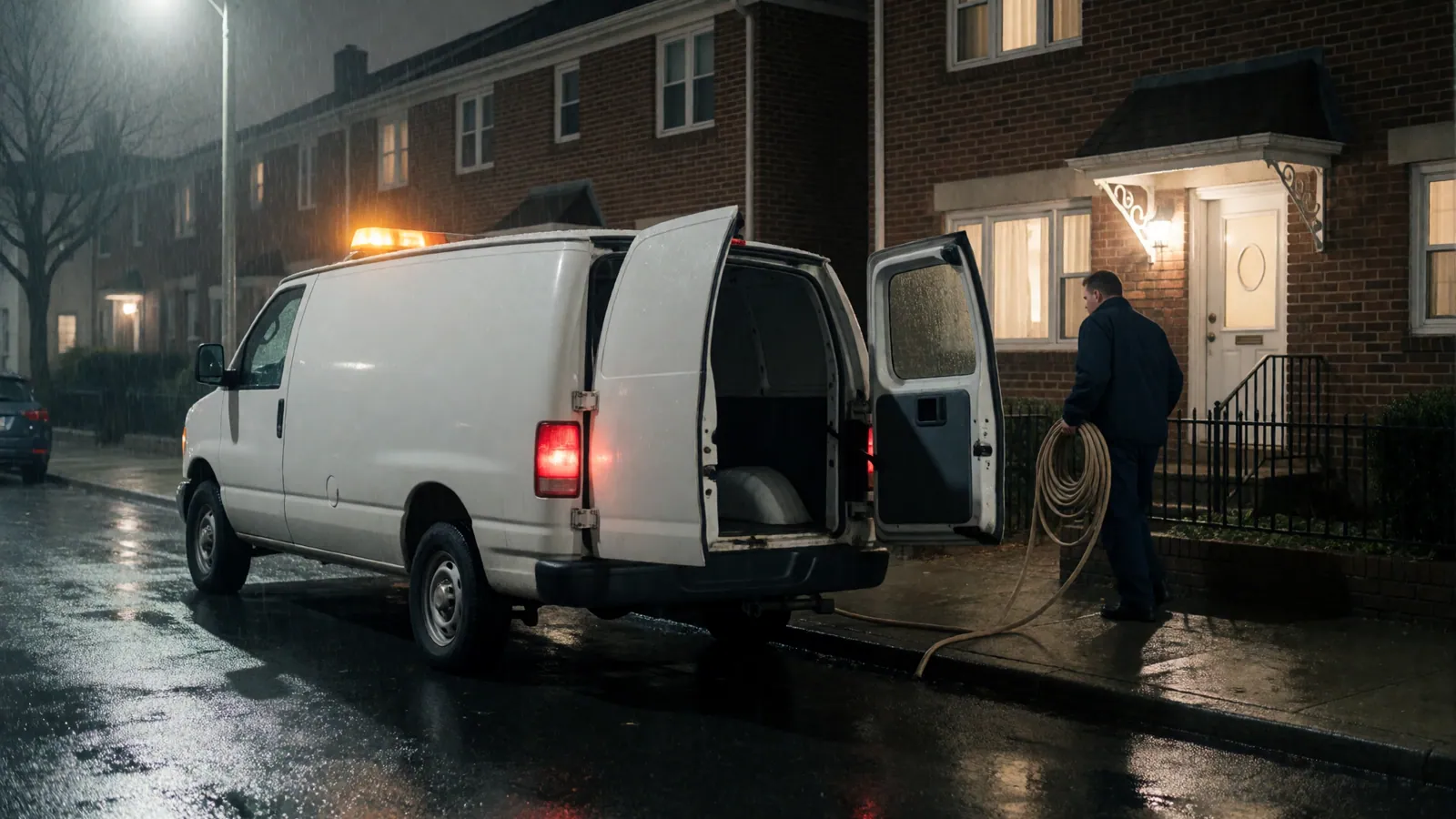
A real person, and a real time. The night telephone is carried by somebody on this crew, and it is answered by a person who does the work rather than by a call centre booking for a franchise network. That is not the same as promising to be at your door in thirty minutes, and we will not print a number of minutes we cannot keep. What you will get is a real person, an honest answer about when we can be there, what to do in the meantime — and, if the safe thing is to call the fire department or the utility instead of us, that answer immediately and at no charge.
What our emergency line actually promises
Almost every restoration company in New York advertises a twenty-four-hour emergency line, and for a good number of them that means a national call centre which takes your details, opens a file and passes it to whichever subcontractor picks it up in the morning. The line genuinely is twenty-four hours. The response is not, and the two are easy to confuse when you are reading at midnight.
Ours is answered by somebody on this crew. That is a smaller promise than most of the ones you will read tonight and it is one we can actually keep. We will not print a number of minutes. What you get is a person who knows what is in the van, an honest arrival time — including when that is three hours because we are already on a job — and instructions for what to do in the meantime.
And if what you describe is not an emergency, you will be told that, and told what to do in the morning. That conversation costs you nothing and costs us a call-out, which is exactly why it is worth trusting.
Questions people actually ask
Emergencies — frequently asked
When should I ring 911 instead of you?
If there is fire or you smell gas or smoke, ring 911 first, every time. If the building has been hit structurally, or a ceiling has come down, or you can see displaced framing, get everybody out and let the Fire Department decide when it can be re-entered. Nothing inside is worth being in there for.
The basement is flooded. Can I go in?
Not while anything electrical in it is still live. Water and electricity in a basement is the one genuinely lethal combination in this trade, and it kills people who were only trying to rescue a box. If the isolation point is outside the water, switch it off. If the board itself is in the basement or you would have to wade to reach it, that is a call to the utility or an electrician, not a decision to make in the moment.
What should I do while I wait for you?
Stop the water at the stopcock if you can. Isolate power to the affected area if it is safe to do so from outside the water. Photograph everything before you move it. Lift what you can off a wet floor and put foil or blocks under furniture legs. Open windows if the weather allows. Then stop — the rest is our job and it is not worth an injury.
Should I use a household vacuum on standing water?
No. A domestic vacuum is not built for it and it is an electrical appliance in contact with water. A hired wet vacuum on a small clean-water spill on a hard floor is reasonable; anything that has reached carpet, underlay, a cavity or a subfloor is beyond what the machine can usefully do anyway.
Do you charge for coming out at night?
The assessment is free. If we mobilise and start emergency work outside office hours there is a $450 mobilisation charge for two technicians and a first equipment set, and we say that number on the telephone before we set off rather than after we arrive.
What if I am not sure it is an emergency?
Ring anyway and describe it. A large part of what the night telephone does is tell people that what they have will keep until morning, which costs us a call-out and saves you one. Nobody here is paid a commission for turning a question into a visit.
Any hour, any day
Ring, even if you are not sure
A large part of what this telephone does is tell people their problem will keep until morning. That answer is free and it is given honestly, because nobody here is paid a commission for turning a question into a visit.