Why we will not write the report on the job we want to win
Mould testing and the law
New York State forbids one company from both assessing and remediating the same mould job. It is an unusual law, it costs us work, and it is one of the few pieces of consumer protection in this trade that does exactly what it was written to do.
We will not assess the mould we want to remediate. We hold a New York State mould remediation licence. We deliberately do not act as your mould assessor, because under Labor Law Article 32 the same company may not assess and remediate the same project — and that law is right. A company that writes the report and then quotes the work described in the report has a straightforward financial interest in the report saying the job is big. So on any mould job we ask you to appoint an independent licensed assessor, we work to their remediation plan, and they come back and verify our work when we are done. We will find the water for you at no charge, because finding water is not assessing mould. We will not sell you a test and then sell you the cure for what the test found.
What Article 32 actually says
New York State licenses this work through the Department of Labor under Labor Law Article 32, and it creates separate licences for separate roles. A mould assessor inspects, samples where sampling is warranted, and writes a remediation plan. A mould remediation contractor carries out that plan. The law prohibits the same company from performing both functions on the same project.
That is a stronger rule than most people expect from a licensing statute, and it exists because of a conflict of interest that is otherwise unavoidable. If the company that writes the report is the company that quotes the work described in the report, then every additional square foot of contamination the report finds is additional revenue for its author. That does not make everybody dishonest. It makes honest reports impossible to tell apart from self-interested ones, which in practice is almost as bad.
What that means for your job
We hold a remediation licence. On a mould job we are the remediator, which means we are not, and cannot be, your assessor. So the sequence is: you appoint an independent licensed assessor; they inspect and write a remediation plan; we quote and carry out that plan; and they return at the end and verify our work against the plan they wrote.
You pay two parties instead of one. In exchange, the document that decides the size of the job was written by somebody with nothing to gain from it being large, and the person confirming the work was done properly is not the person who did it. On a job of any size that is the best few hundred dollars in the whole project.
Finding the water is not assessing the mould
There is one part of this we do at no charge, and it is worth explaining why we are allowed to.
Mould is a symptom. It grows because something is wet, and if the water is still arriving then remediation is an expensive way of waiting for it to come back. Tracing that water — a meter survey, a thermal sweep, finding the failed seal or the cracked waste or the cold bridge — is an investigation into plumbing and building fabric. It is not an assessment of mould, it produces no remediation plan, and it does not put us on both sides of the line the statute draws.
So we will find your water for nothing, tell you what has to be fixed and by whom, and then step back and ask you to appoint somebody else to assess the mould. Occasionally that conversation ends with the customer fixing a leak, drying a cupboard and never needing us at all. That is a good outcome and we would rather have it than the alternative.
What we will not tell you
We will not tell you what mould in your home is doing to anybody's health, in either direction. Not that it is dangerous, and not that it is harmless. Nobody here is medically qualified, and the fear around this subject is the most reliably profitable thing in the whole trade — which is precisely why a contractor is the last person who should be speaking to it.
What we can tell you is what is measurable: where the water is, how far it has gone, what is growing and over what area, and what we would remove. If you are worried about your health, that conversation belongs with your physician, and it should happen before ours rather than after it.
Nobody here is a doctor. Nobody here is a doctor, and nothing on this website is medical advice. We will not tell you that mould in your home has made you ill, that it has not, or what any symptom means — those are questions for your physician, and a contractor who answers them is selling something. What we can tell you is what we can measure: where the water is, how far it has travelled, what is growing and over how large an area. If you are worried about your health, ring your doctor first and us second.
How a mould job runs here
Five steps, and two of them are not ours
We find the water, at no charge
A meter and thermal survey to establish where it is coming from and how far it has travelled. If the source is still live, that gets fixed before anything else is worth doing.
You appoint an independent assessor
Licensed by the Department of Labor, working for you, and unconnected to us. They inspect and write the remediation plan.
We quote against their plan
To the scope they wrote, not to a scope we invented. If we think their plan is wrong we will say so to you and to them, in writing, rather than quietly pricing something different.
We remediate
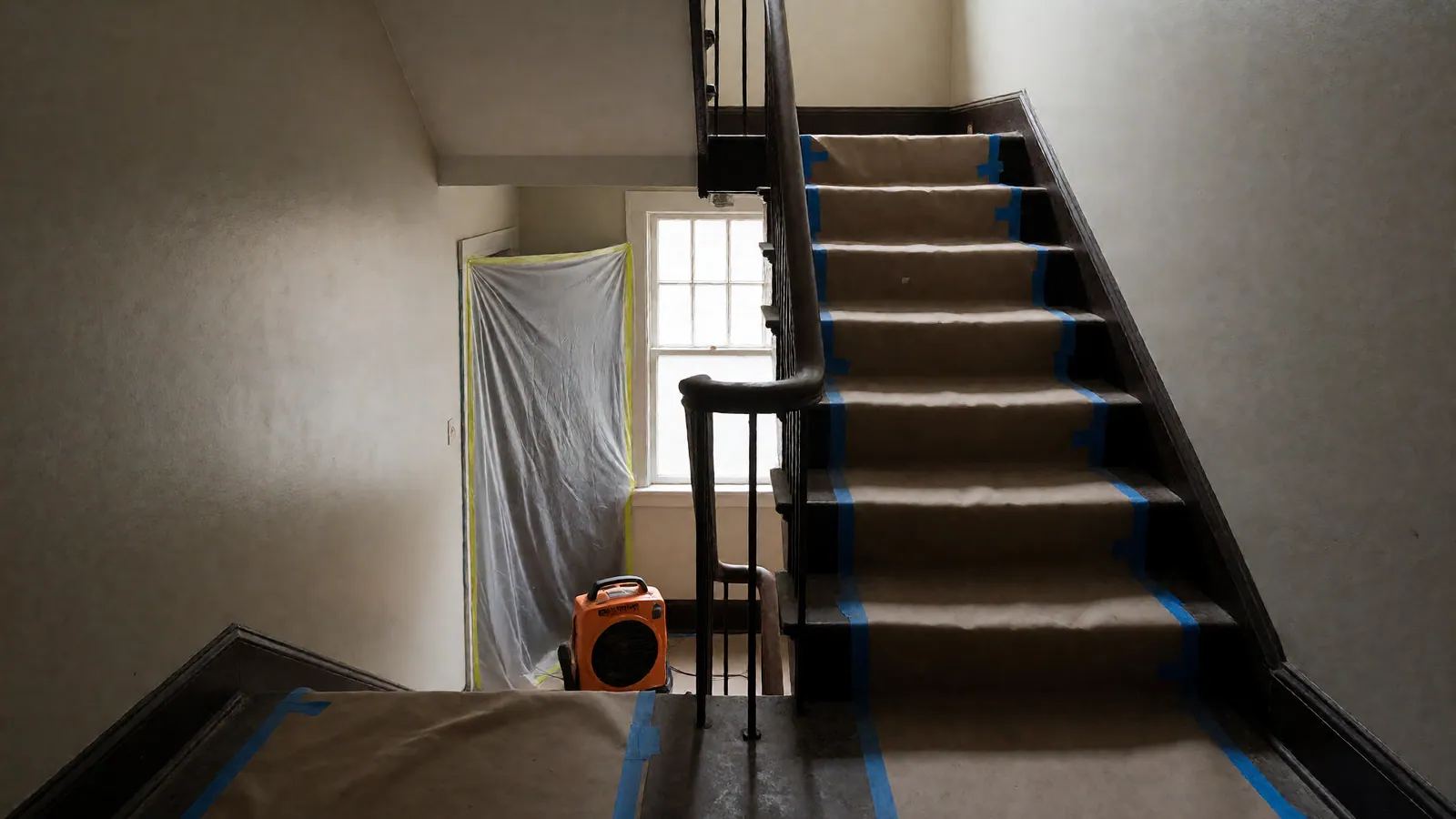
Containment, negative air with filtration, removal of affected porous material, HEPA vacuuming and damp wiping, then antimicrobial on cleaned surfaces — after the cleaning, never instead of it.
Your assessor verifies the work
They return and check what we did against what they specified. The person confirming the job is neither the person who did it nor the person paid for it.
Our credentials, stated plainly
What we hold, and what we deliberately do not
“Licensed and insured” appears on every contractor's website in this city, including the ones that are neither. What carries information is a licence type, a number, and the fact that you can check it against a public record without asking us.
- Remediation licenceNew York State mould remediation contractor — 00000, a placeholder, see below
- Assessment licenceNot held, and not used on your project. That is the point of this page.
- Home improvement licenceNew York City Home Improvement Contractor — 00000, also a placeholder
- Contracting entityWoodside Water & Fire Restoration, LLC
- Liability & workers' compensationCertificates sent on request, direct from the insurer
- Accreditations claimedNone. No trade-body badge, no directory rating, no insurer's panel.
The licence numbers above are deliberately the same placeholder as the telephone number. This is a demonstration website for a business that does not exist, and real licence numbers belong to real people and real companies — inventing plausible ones would attach somebody's actual credential to a fiction. When you check a real contractor, ask for the number and the name it is held in, and verify it against the state's own records rather than a badge on a website.
Questions people actually ask
Mould testing — frequently asked
Why can't you inspect the mould yourselves?
Because New York Labor Law Article 32 does not allow it. The law licenses mould assessors and mould remediators separately, and it forbids the same company from performing the assessment and the remediation on the same project. We hold a remediation licence. On your job we are the remediator, so we cannot be your assessor — and we think the rule is right.
Isn't that just extra cost for me?
It is a separate fee, and it is worth it. The alternative is that the company quoting the removal also writes the report that says how much removal is needed. Nobody is well served by that, including honest contractors, because it makes an honest report indistinguishable from a self-interested one. Paying an independent assessor buys you a document whose author has nothing to gain from the answer.
Do I always need an assessment?
No. If you can see mould, you know where the water came from, and the affected area is small, a test mostly confirms what you already know. Where an assessment genuinely earns its fee is when something is wrong and nobody can find it, when the area is large, when a tenant or a managing agent is involved, or when you want an independent record of the condition before and after.
Will you tell me whether the mould is affecting my health?
No, and please be wary of any contractor who will. Nobody here is medically qualified and nothing on this site is medical advice. We can tell you what we can measure — where the water is, how far it has travelled, what is growing and over how large an area. What that means for a person is a question for a physician.
Does bleach work?
On a hard, non-porous surface it will remove the staining. On anything porous — plasterboard, timber, plaster, fabric — it is largely water carrying a small amount of chlorine, the water feeds the underlying problem, and the growth is inside the material rather than on it. Remediation removes affected porous material rather than bleaching it, which is less satisfying and considerably more effective.
What does the assessor do at the end?
They come back and verify the work against the remediation plan they wrote. That is the point of the separation: the person checking whether the job was done properly is not the person who did it and not the person who was paid for it.
Start with the water
Think you have a mould problem?
Ring us and we will come and find the water at no charge, which is the half that decides whether you have a remediation problem or a plumbing one. Then we will tell you whether you need an assessor at all, and how to appoint one who is nothing to do with us.