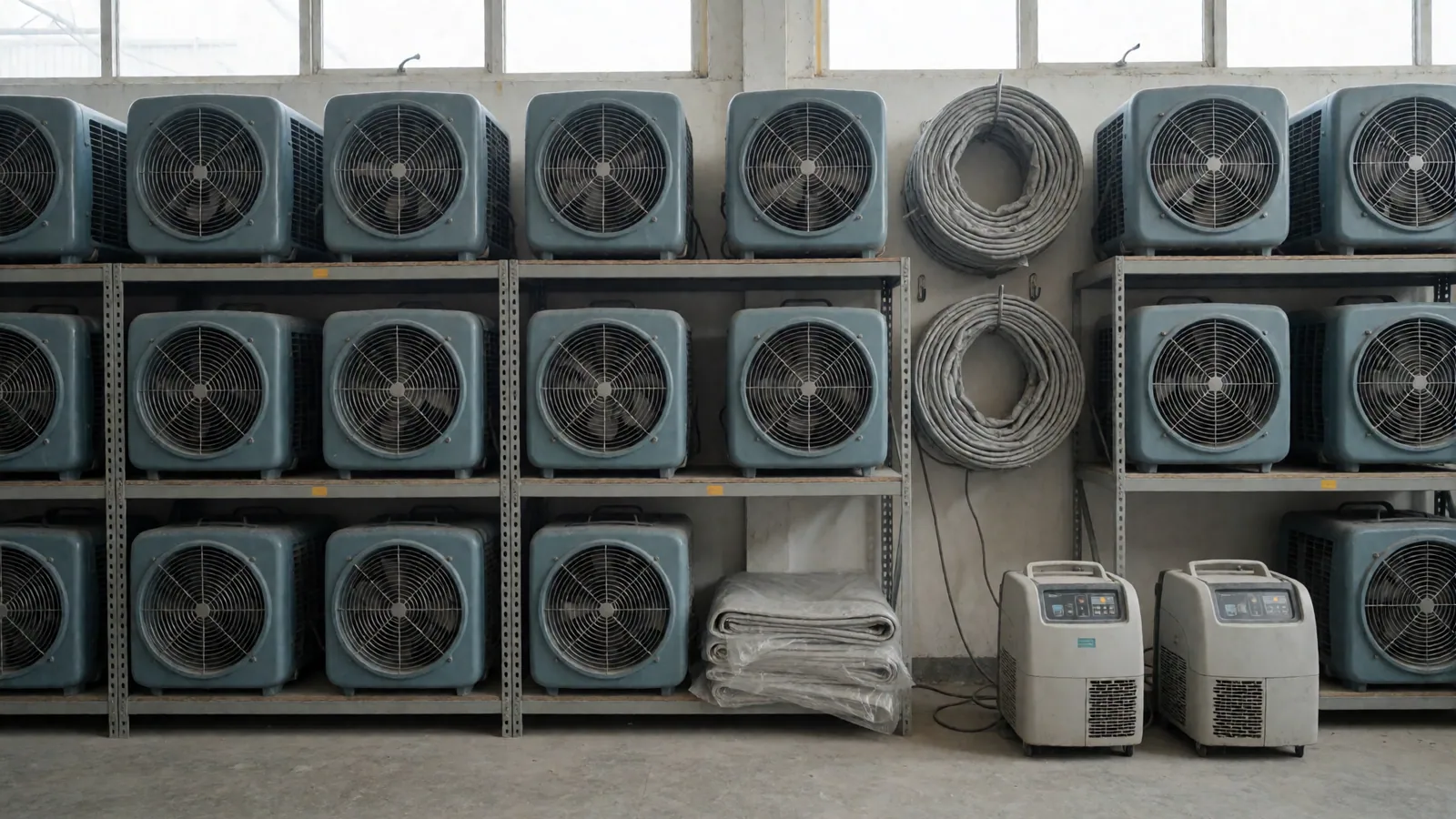
The number of days is an output, not a promise
How drying actually works
Every restoration company in this city advertises a drying time and none of them can know it before taking a reading. Here is what actually decides it, what the daily visit is for, and why we will not certify anything.
The readings decide when the equipment leaves. We will not promise you a number of days. A structure is dry when its materials reach the moisture content of comparable dry materials in the same building — which depends on what the materials are, how much water they took, how warm it is and how much of the wet is trapped behind something. Most residential water losses dry in three to five days and we will tell you which end we expect yours to land on, but that is a forecast from readings, not a guarantee, and the readings decide when the equipment leaves. Nor will anybody here certify your home dry, mould-free or safe. A drying log records what was measured, where, and on which day. That is a real document. A certificate of dryness is not.
Dry is a comparison, not a feeling
A material is dry when it has come back to the moisture content of comparable unaffected material in the same building. Not when it feels dry, not when it looks dry, and not on a particular day. That definition is why every honest drying log contains a reference reading taken somewhere the water never reached — because without something to compare against, a number off a meter is just a number.
It also explains why the same loss dries differently in two houses. A reference reading in a well-heated apartment in March is not the reference reading in an unheated Queens basement in November, and the target moves with it.
Four things are being balanced, and you cannot substitute one for another
Airflow moves air across wet surfaces, which is what makes water leave the material. Dehumidification takes that water out of the room air, which is what stops it landing on a cold surface two rooms away — a badly run dry-out reliably creates a second problem somewhere else in the building. Temperature helps, because warm air holds more water. And time is what the other three buy.
The seductive mistake is thinking equipment count is a dial you can turn. It is not. Past a certain point the material itself is the limiting factor and additional machines contribute nothing but noise and an electricity bill. Twice the air movers does not mean half the days, and a contractor who fills your house with equipment is not necessarily drying it faster.
What actually sets the number of days
What the materials are: solid timber holds and releases water slowly, plasterboard quickly, plaster on lath somewhere maddeningly in between, and masonry slowest of all — which is why basements routinely take a week where an upstairs room takes three. How much water they took. How warm the building is and, more importantly, stays. And the one that wrecks schedules: how much of the wet is trapped behind something that has to be opened before it can be dried at all.
Two of those four are outside anybody's control. That is the whole reason we give you a forecast and then revise it out loud on day three or four rather than quietly running equipment past a promised date.
Why we will not certify
You may be offered a certificate saying your home is dry, or safe, or free of mould. There is no such thing, and the reason is not legal caution — it is that nobody can inspect a whole building. Every reading is a reading at a point. Every survey has a list of what could not be reached, and on an occupied house that list is never empty.
So what you get from us is a drying log: what was measured, at which marked point, on which date, with which instrument, against which reference, and what we could not reach. It is a document a stranger could check and could disagree with. That is precisely what makes it worth more than a certificate.
What happens every day the equipment is in
The monitoring visit
Readings at the same marked points
Same instrument, same places, so today's number means something against yesterday's rather than describing a different bit of wall.
A reference reading
Taken from an unaffected area of the same building, because the target is a comparison and it moves with the weather.
The dehumidifier checked, not glanced at
Confirming it is actually pulling water rather than merely running, which is a failure mode nobody notices from the doorway.
Air movers repositioned
As the wet area shrinks the machines follow it. Equipment aimed at dry wall is decoration.
Machines removed as they stop earning
You should not be charged for a fan with nothing left to do, and the equipment log records the day each one came off.
The log updated and dated
Your copy and your insurer's, if there is a claim. This is the document that answers “why was it there for six days”.
Warning signs
How to tell a drying job is being done badly
Most of these are visible to somebody with no technical knowledge at all, which is the point of listing them.
- A day count given before a readingThe number cannot be known before the measurement. If it arrives first, it is marketing.
- Nobody visitingEquipment running for days with no readings taken is equipment being rented to you, not a drying plan.
- No reference readingIf the paperwork has no reading from an unaffected area, there is nothing to compare against and “dry” means whatever the contractor says.
- Condensation in other roomsMoisture is being moved around the building rather than taken out of it. That is a dehumidification failure and it creates a second problem.
- Closing up earlySkirting refitted or a wall boarded over while the timber behind it is still damp. This is how a water job becomes a mould job a fortnight later.
- A certificate at the endThere is no certificate of dryness. A dated log with limitations is the real document.
Questions people actually ask
Drying — frequently asked
How long will my house take to dry?
Most residential water losses dry in three to five days, and we will tell you which end we expect yours to land on. That is a forecast from readings rather than a promise, because four variables decide it and only two of them are ours. The readings decide when the equipment leaves.
What does 'dry' actually mean?
That the affected materials have reached the moisture content of comparable unaffected materials in the same building — measured with the same instrument, at marked points, against a reference reading. Dry is a comparison rather than a number in isolation, and it is why every proper drying log has a reference in it.
Why do you need to come every day?
To take readings at the same points, check that the dehumidifier is actually pulling water rather than merely running, move air movers as the wet area shrinks, and take machines away when they stop earning their place. A drying job with no daily readings has no evidence behind it, and you should be suspicious of one.
Can I turn the equipment off at night?
Please do not. Drying is continuous, and eight hours off lets moisture redistribute through the materials, which costs more than the night's electricity saves. If the noise is genuinely unbearable, tell us — there are usually placements that help.
Will you certify my house is dry?
No, and nobody honest will. What we will give you is a dated record of what was measured, where, on which day, with which instrument, against which reference. That is a document somebody else can check and disagree with, which is what makes it worth having. A certificate of dryness is a decoration.
What if it does not dry?
Then something is still wet that we have not reached, and the answer is to find it rather than to run the machines longer. Trapped water behind a cabinet, in a cavity or under a floor does not respond to more airflow in the room. We would rather open something small on day four than hand you a dry-looking room with a problem inside it.
Second opinion, no charge
Somebody else is drying your house
If equipment has been running for a week with nobody taking a reading, ring us. We will come and take readings and tell you honestly where it is — including when the honest answer is that the people already there are doing it properly.